
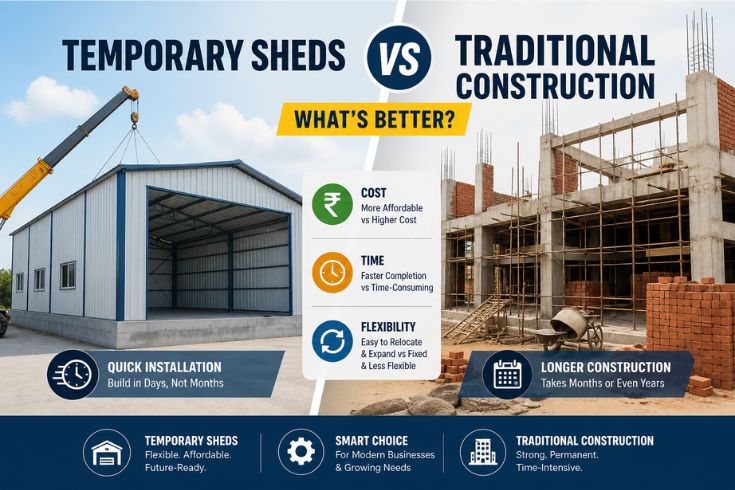
When comparing temporary sheds vs traditional construction, businesses and organizations often focus on cost, speed, and flexibility. Both construction methods serve different purposes, but choosing the right one depends on your project goals, timeline, and budget.
Temporary sheds, also known as prefabricated or modular structures, are built off-site and assembled quickly at the location. These structures are widely used for warehouses, site offices, schools, and NGO projects.
One of the biggest advantages of temporary sheds is speed. Since components are pre-manufactured, installation can be completed within days or weeks. This makes them ideal for urgent requirements such as disaster relief or temporary storage.
In terms of cost, temporary sheds are significantly more affordable than traditional buildings. They require less labor, fewer materials, and minimal foundation work, resulting in lower overall expenses.
Flexibility is another strong benefit. Temporary sheds can be easily relocated, expanded, or dismantled based on changing needs. This adaptability is especially useful for growing businesses or short-term projects.
Traditional construction refers to buildings made using brick, cement, and concrete, constructed entirely on-site. These structures are known for their durability and long-term value.
However, traditional construction requires a longer timeline. From planning and approvals to actual construction, projects can take several months or even years to complete.
The cost of traditional buildings is also higher due to raw materials, labor, and extended project durations. Additionally, unexpected delays can further increase expenses.
While traditional buildings offer permanence and strength, they lack flexibility. Once constructed, modifications or expansions can be expensive and time-consuming.
1. Cost:
Temporary sheds are budget-friendly, making them ideal for startups and temporary needs. Traditional construction involves higher upfront investment.
2. Time:
Temporary sheds can be installed quickly, whereas traditional construction takes significantly longer.
3. Flexibility:
Temporary sheds offer easy relocation and expansion. Traditional buildings are fixed and less adaptable.
4. Durability:
Traditional construction provides long-term durability, while temporary sheds are designed for medium to long-term use depending on quality.
5. Use Cases:
Temporary sheds are best for warehouses, site offices, and temporary housing. Traditional construction is suitable for permanent homes, offices, and infrastructure.
The choice between temporary sheds vs traditional construction depends on your specific needs. If you require a fast, cost-effective, and flexible solution, temporary sheds are the better option. On the other hand, if your priority is long-term durability and permanence, traditional construction is more suitable.
Both construction methods have their advantages, but modern industries are increasingly leaning towards temporary sheds due to their efficiency and adaptability. By evaluating your budget, timeline, and project requirements, you can make an informed decision that aligns with your goals.
WhatsApp us