
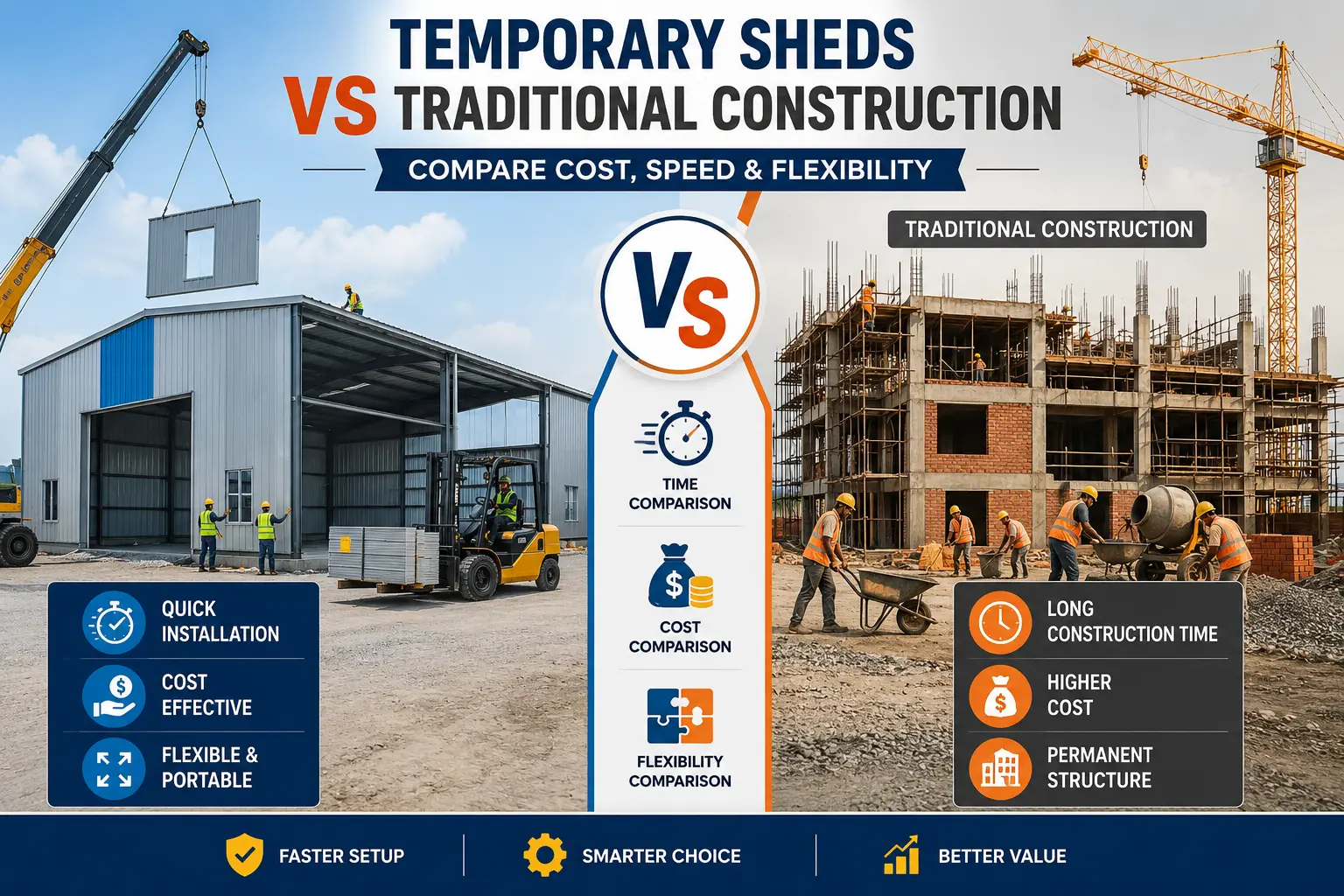
In today’s fast-moving construction industry, temporary sheds are becoming a popular alternative to traditional construction methods. Businesses, construction companies, warehouses, event organizers, and industrial projects are increasingly choosing prefabricated solutions because they save time, reduce costs, and offer better flexibility. But does that mean traditional construction is outdated? Understanding the differences between temporary sheds and conventional buildings can help you make the right decision for your project.
Temporary sheds are prefabricated or modular structures designed for quick installation and short-term or semi-permanent use. These sheds are commonly used for construction sites, storage units, industrial workspaces, temporary offices, event halls, and labor accommodations.
Unlike traditional construction, temporary sheds are manufactured in sections and assembled on-site. This process significantly reduces labor requirements and construction time.
Traditional construction refers to conventional building methods using brick, cement, concrete, steel, and other permanent materials. These buildings are usually designed for long-term use and require extensive planning, labor, and time for completion.
While traditional construction provides durability and customization, it often involves higher expenses and longer project timelines.
One of the biggest advantages of temporary sheds is affordability. Prefabricated structures generally cost less because they require fewer materials, less labor, and reduced construction time.
Traditional construction involves higher expenses due to raw material costs, skilled labor charges, foundation work, and longer project durations. Unexpected delays can also increase the overall budget.
For businesses looking for economical infrastructure solutions, temporary sheds provide excellent value without compromising functionality.
Speed is another major factor where temporary sheds outperform conventional buildings. Prefabricated sheds can often be installed within days or weeks depending on the project size.
Traditional construction projects may take several months or even years to complete because of excavation, curing time, weather conditions, and multiple construction stages.
For industries that need immediate operational space, temporary sheds are a practical and time-saving solution.
Temporary sheds are highly flexible and can be expanded, relocated, or modified whenever required. This makes them ideal for growing businesses, temporary operations, and seasonal activities.
Traditional buildings are permanent structures and cannot be moved easily. Any modifications usually require demolition, reconstruction, and additional investment.
If your project demands adaptability, temporary sheds offer greater convenience and scalability.
Traditional construction is known for long-term durability and strength. Permanent buildings can last for decades with proper maintenance.
However, modern temporary sheds are also designed using high-quality steel and weather-resistant materials, making them durable enough for industrial and commercial use. They also require lower maintenance compared to conventional structures.
The right choice depends on whether you need a permanent setup or a flexible infrastructure solution.
Choosing between temporary sheds and traditional construction depends on your project goals, budget, and timeline. If you need a fast, cost-effective, and flexible solution, temporary sheds are the better option. On the other hand, if you require a long-term permanent structure with extensive customization, traditional construction may be more suitable.
Today, many industries are shifting toward prefabricated infrastructure because of its efficiency, affordability, and quick deployment. As construction technology continues to evolve, temporary sheds are becoming an essential part of modern infrastructure development.
WhatsApp us