
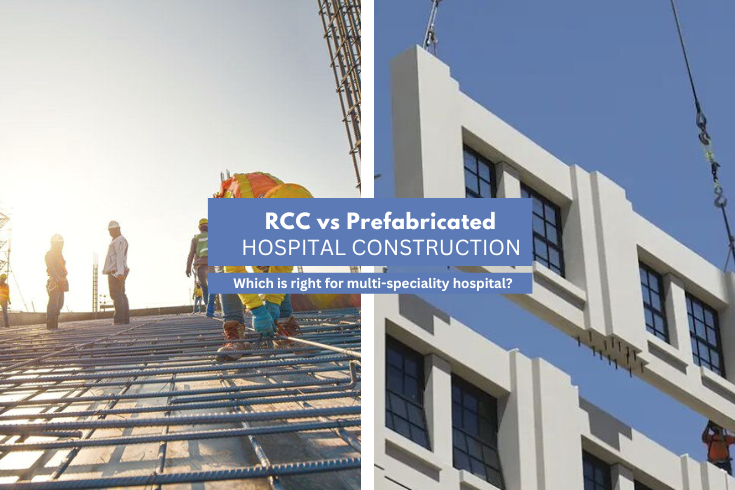
Choosing the right construction method is a critical decision when planning a multi-specialty hospital. Developers and healthcare investors often face a common dilemma: RCC vs prefabricated hospital construction. Both methods offer unique advantages, but the right choice depends on project size, timeline, budget, and long-term operational goals.
This blog explains RCC vs prefabricated hospital construction, including cost, speed, durability, and suitability, along with clear pros and cons.
Replotify works with three modern prefab construction techniques, each offering unique benefits:
RCC (Reinforced Cement Concrete) construction is the traditional method used for decades in hospital buildings. It involves on-site concrete casting with steel reinforcement, brick or block walls, and conventional finishing.
RCC is widely preferred for large hospitals because of its strength, load-bearing capacity, and long lifespan.
Prefabricated hospital construction uses factory-manufactured components such as cement panels, EPS panels, or sandwich PUF panels, which are assembled on-site. In most cases, prefab systems are combined with RCC or steel structures, especially for hospitals.
When comparing RCC vs prefabricated hospital construction, prefab methods are known for speed, precision, and flexibility.
Pros:
High structural strength for heavy medical equipment
Long lifespan (50+ years)
Easy statutory approvals
Suitable for basements and high-rise buildings
Cons:
Longer construction time
Higher labor dependency
Delayed return on investment
Difficult future modifications
Pros:
Cost-effective in the long run due to reduced construction time and early project completion
More options for customization, including room layouts, wall finishes, insulation types, and façade designs
Faster construction speed, enabling hospitals to start operations earlier
Better thermal and acoustic performance, ideal for wards, ICUs, and patient rooms
High-quality factory-controlled production, ensuring uniformity and precision
Minimal on-site disruption, cleaner and safer construction environment
Easy future expansion or modification, without disturbing existing hospital operations
Sustainable construction, with less material waste and lower carbon footprint
Cons:
Heavy equipment areas still need RCC floors
Limited awareness among local authorities
When evaluating RCC vs prefabricated hospital construction, most modern healthcare projects adopt a hybrid approach. RCC is used for foundations, ICUs, operation theaters, and diagnostic areas, while prefabricated cement or sandwich panels are used for wards, OPDs, and administrative blocks.
This combination delivers structural safety, faster delivery, and long-term flexibility, making it ideal for multi-specialty hospitals.
There is no one-size-fits-all answer in the debate of RCC vs prefabricated hospital construction. RCC offers unmatched strength, while prefabricated systems provide speed and efficiency. A hybrid construction model balances both and is increasingly becoming the preferred choice for hospital developers in India.
What do you think is best for your hospital project: sticking to RCC or exploring prefabricated construction with better speed and customization?
WhatsApp us