
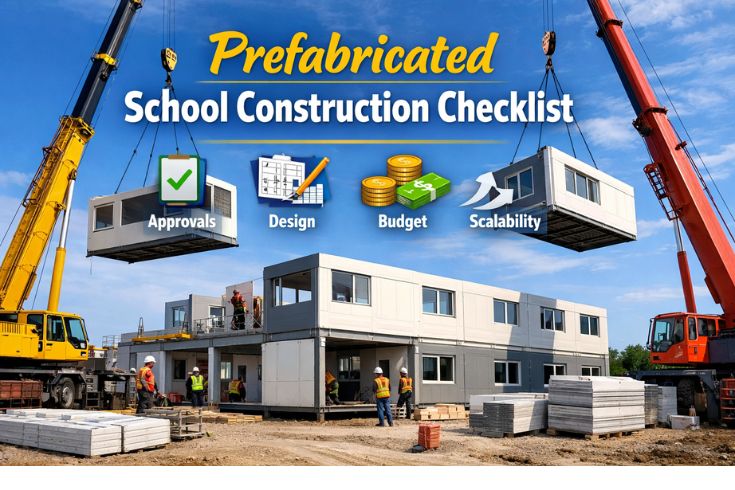
Key Planning Checklist Before Starting a School Construction Project with Prefabricated Materials
Starting a school construction project using prefabricated materials is a smart and modern approach to building educational infrastructure. A well-defined key planning checklist before starting a school construction project with prefabricated materials helps ensure efficiency, cost savings, and long-term scalability. By focusing on approvals, design, budget, and scalability, institutions can achieve faster project completion without compromising quality.
1. Approvals and Compliance
The first step in any school construction project is securing all required approvals. Even when using prefabricated materials, you must obtain land permissions, zoning clearances, and safety certifications from local authorities.
Prefabricated construction often meets environmental and structural standards more easily, but compliance is still essential. Ensuring all approvals are in place avoids legal issues and project delays, making the construction process smooth and reliable.
2. Efficient and Modern Design
Design plays a crucial role in prefabricated school construction. Since prefabricated structures are manufactured off-site and assembled on-site, the design must be precise and well-planned from the beginning.
A smart design should include proper classroom layouts, ventilation, lighting, and digital infrastructure. Prefabricated materials allow flexible layouts, enabling quick customization of classrooms, labs, and activity spaces. A well-designed prefabricated school ensures functionality, comfort, and a better learning environment.
3. Budget Planning and Cost Efficiency
One of the biggest advantages of prefabricated materials is cost control. A detailed budget plan should include manufacturing, transportation, assembly, labor, and finishing costs.
Prefabricated construction reduces material wastage and construction time, leading to significant savings. However, it is important to plan for hidden costs such as site preparation and utility connections. Proper budget planning ensures the school construction project stays within financial limits while maintaining quality standards.
4. Scalability and Future Expansion
Scalability is a major benefit of prefabricated school construction. Institutions can easily expand their infrastructure by adding new modules or sections without disrupting existing structures.
Planning for future growth is essential in the key planning checklist before starting a school construction project with prefabricated materials. Whether it’s increasing classroom capacity or adding new facilities, prefabricated systems make expansion faster and more efficient.
5. Speed and Project Timeline
Prefabricated construction significantly reduces project timelines compared to traditional methods. Since components are built off-site, on-site work is minimized, leading to faster completion.
This speed is especially beneficial for schools that need to start operations quickly. With proper planning and coordination, the project can be completed within a fixed schedule without delays.
6. Quality and Sustainability
Prefabricated materials are manufactured in controlled environments, ensuring consistent quality and durability. These structures are also environmentally friendly, as they reduce waste and promote energy efficiency.
Using sustainable materials and energy-efficient designs enhances the long-term value of the school infrastructure while reducing operational costs.
Following a key planning checklist before starting a school construction project with prefabricated materials ensures a faster, cost-effective, and scalable solution. By focusing on approvals, design, budget, and scalability, educational institutions can build modern, efficient, and future-ready campuses. Prefabricated construction not only saves time and money but also delivers high-quality infrastructure for long-term success