
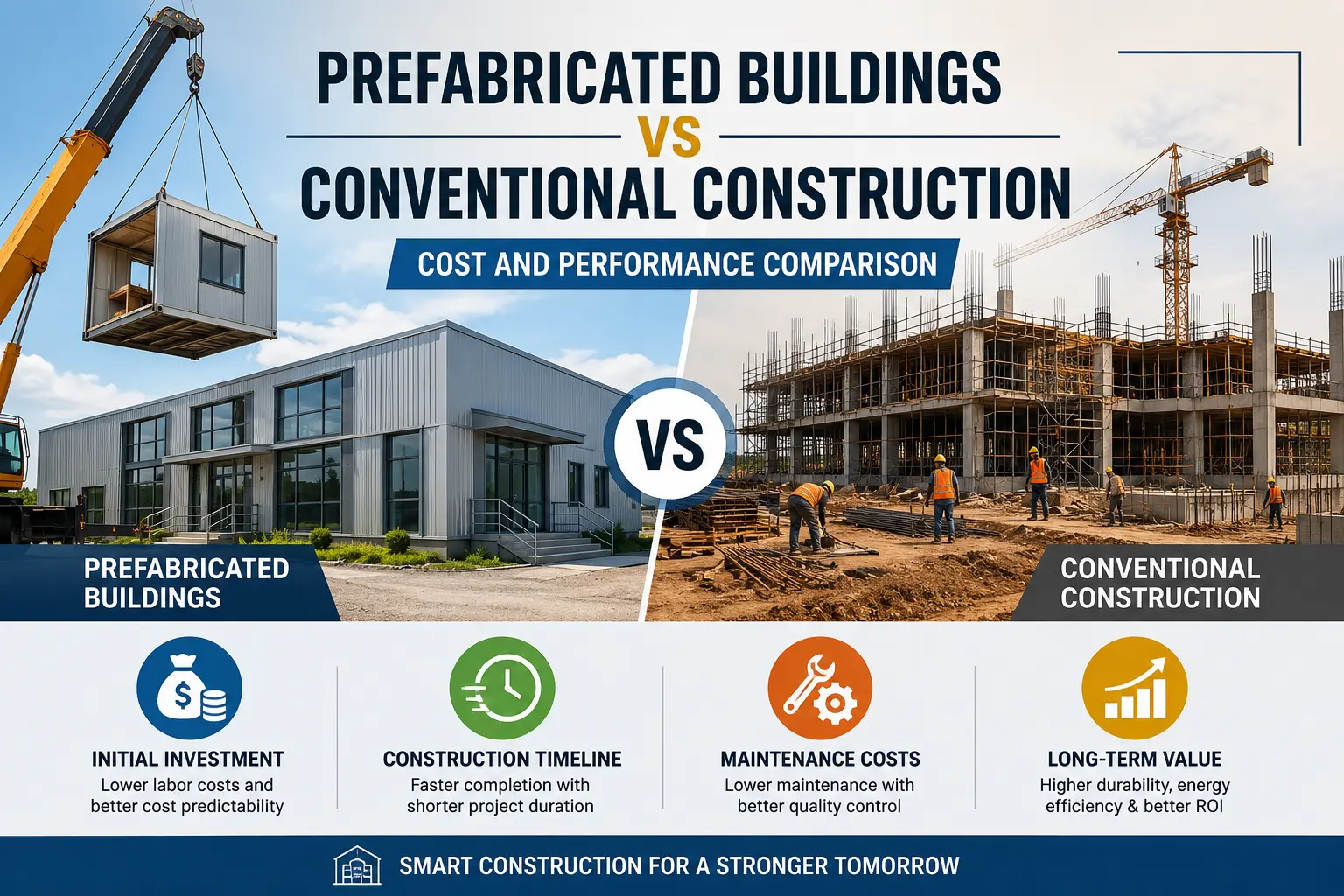
When planning a construction project, one of the most important decisions is choosing the right construction method. Businesses today are increasingly comparing prefab vs conventional construction to determine which option offers better value, faster completion, and long-term performance.
Traditional construction has been the preferred approach for decades, but prefabricated buildings have transformed the industry by offering efficient, cost-effective, and sustainable alternatives. Whether you’re building a warehouse, factory, commercial office, healthcare facility, school, or temporary structure, understanding the differences between these construction methods can help you make an informed investment.
In this guide, we’ll compare prefabricated and conventional construction based on four key factors: initial investment, construction timeline, maintenance costs, and long-term value.
Prefabricated construction, also known as modular construction, involves manufacturing building components in a controlled factory environment. Once completed, these components are transported to the project site, where they are assembled into a finished building.
Because manufacturing takes place indoors, production is not affected by weather conditions. Factory-controlled processes also ensure consistent quality, better precision, and reduced material waste.
Prefabricated construction is widely used for:
Conventional construction is the traditional method where all building activities take place on-site. Materials such as cement, bricks, steel, sand, and concrete are delivered to the location, and construction progresses step by step.
The process typically includes:
While this method allows extensive architectural customization, project timelines often depend on labor availability, weather conditions, and site management.
One of the first questions clients ask is, “Which option is more affordable?”
When comparing prefab vs conventional construction, the answer depends on project size, building type, and customization requirements.
Although factory manufacturing requires specialized equipment, prefabricated construction reduces several major expenses, including:
Since components are manufactured with precision, budgeting is more predictable and unexpected costs are minimized.
Traditional construction often experiences fluctuating costs due to:
As a result, project budgets can increase during construction.
Verdict: Prefabricated buildings generally offer better cost control and more predictable project budgets.
Project completion time directly affects operational costs and business productivity.
One of the biggest advantages of prefabrication is speed.
While the building components are manufactured in the factory, foundation work is completed simultaneously at the project site. This parallel workflow significantly reduces the total construction duration.
Benefits include:
Many prefab projects are completed 30–50% faster than conventional construction.
Traditional projects follow a sequential process, meaning each stage begins only after the previous one is completed.
Delays can occur because of:
These factors can extend project timelines and increase overall costs.
Verdict: Prefabricated construction delivers projects much faster than conventional methods.
Construction costs don’t end when the building is completed. Long-term maintenance plays an important role in the overall investment.
Modern modular buildings are manufactured using advanced engineering techniques and strict quality control.
Benefits include:
Since quality is monitored throughout factory production, buildings often require fewer maintenance interventions.
Maintenance costs for traditional buildings may increase over time due to:
Routine inspections and maintenance remain essential to preserve building performance.
Verdict: Prefabricated buildings typically require lower maintenance throughout their lifecycle.
Long-term value depends on durability, operating costs, and return on investment.
Modern prefab buildings offer:
These advantages make prefabricated buildings an attractive solution for growing businesses.
Traditional buildings remain valuable, particularly for projects requiring unique architectural designs or specialized structural layouts.
However, longer construction periods and higher maintenance costs may increase the total lifecycle investment.
Verdict: Prefabricated buildings provide stronger long-term value for most commercial and industrial applications.
The best choice depends on your project objectives.
Choose prefabricated construction if your priorities include:
Choose conventional construction if your project requires:
The comparison between prefab vs conventional construction clearly shows why prefabricated buildings are becoming the preferred choice for modern construction projects. They offer faster completion, predictable budgets, reduced maintenance, improved quality control, and better long-term value.
While conventional construction continues to serve projects with unique design requirements, businesses looking for speed, efficiency, and cost savings increasingly turn to prefabricated solutions.
Whether you’re planning an industrial facility, warehouse, commercial office, healthcare center, educational institution, or temporary structure, investing in prefabricated construction can help you reduce costs, shorten project timelines, and achieve a faster return on investment.
If you’re looking for a reliable partner to deliver high-quality prefabricated building solutions, Replotify offers customized modular construction services designed to meet your project requirements with efficiency, durability, and long-term performance.
WhatsApp us