
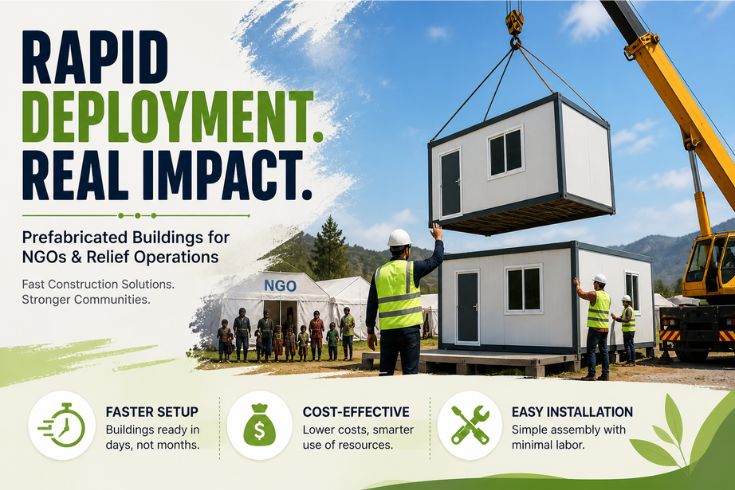
Why NGOs Prefer Prefabricated NGO Buildings for Fast Construction Solutions
In today’s fast-changing world, non-governmental organizations (NGOs) often operate in challenging environments where time, cost, and efficiency are critical. Whether it’s disaster relief, rural education, or healthcare support, infrastructure needs to be deployed quickly and effectively. This is where prefabricated NGO buildings have emerged as a game-changing solution.
Speed: The Biggest Advantage
One of the primary reasons NGOs prefer fast construction solutions is speed. Traditional construction methods can take months to complete, involving multiple stages such as foundation work, curing, and finishing. In contrast, prefabricated structures are manufactured off-site and assembled on location in a fraction of the time.
This rapid deployment is especially crucial during emergencies like natural disasters, where NGOs need to set up shelters, clinics, or schools immediately. With prefabrication, buildings can be ready within days or weeks, allowing organizations to focus on delivering aid rather than waiting for infrastructure.
Cost-Effectiveness for Budget-Conscious Projects
NGOs often work with limited budgets and rely heavily on donor funding. Managing costs efficiently is essential. Prefabricated NGO buildings offer a cost-effective alternative to traditional construction by reducing labor costs, material wastage, and project delays.
Since most components are produced in a controlled factory environment, there is better resource optimization and minimal on-site expenses. Additionally, faster project completion means lower overall operational costs, making prefabrication an ideal choice for NGOs looking to maximize impact with limited resources.
Easy Installation and Flexibility
Another major advantage of fast construction solutions is the ease of installation. Prefabricated buildings are designed for quick assembly, often requiring minimal skilled labor and equipment. This makes them highly suitable for remote or underdeveloped areas where access to skilled workers and construction tools is limited.
Moreover, these structures are highly flexible and can be customized based on the NGO’s needs. Whether it’s a temporary shelter, classroom, medical unit, or office space, prefabricated buildings can be designed to suit various applications. They can also be relocated or expanded as project requirements evolve.
Sustainability and Reduced Environmental Impact
Sustainability is becoming increasingly important for NGOs. Prefabricated construction supports eco-friendly practices by minimizing waste, reducing site disturbance, and using energy-efficient materials.
Because components are manufactured in a factory, there is better control over material usage, leading to less environmental impact compared to conventional construction methods. This aligns well with the values of many NGOs focused on sustainable development.
Ideal for Diverse NGO Applications
From disaster relief camps to long-term development projects, prefabricated NGO buildings are versatile enough to meet a wide range of needs. NGOs can deploy these structures for:
- Emergency shelters
- Healthcare clinics
- Educational facilities
- Administrative offices
Their adaptability and efficiency make them a reliable infrastructure solution in both urgent and planned scenarios.
The growing demand for quick, affordable, and reliable infrastructure has made fast construction solutions like prefabrication a preferred choice for NGOs. With benefits such as rapid deployment, cost-effectiveness, easy installation, and sustainability, prefabricated NGO buildings are transforming how organizations deliver impact on the ground.
For NGOs aiming to respond faster and operate smarter, prefabricated construction is not just an option it’s a strategic advantage.