
Prefabricated Construction in India vs Global: Usage Data & Future Growth
Prefabricated construction in India is steadily gaining attention, but how does it actually compare with global usage? While the concept of prefab construction is transforming the global building industry, the adoption levels reveal an interesting gap and a massive opportunity.
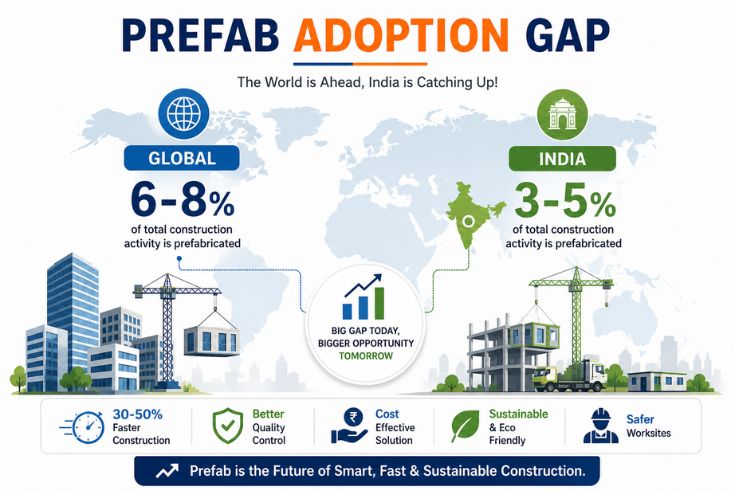
Across the world, prefabricated construction is becoming a powerful solution for faster and more efficient building. However, despite its advantages, prefab currently accounts for only 6% to 8% of total global construction activity. This means that over 90% of construction worldwide still relies on traditional methods. Developed countries like the USA, Germany, and Japan are leading adopters, where prefabrication is widely used in housing, commercial spaces, and infrastructure projects.
The global growth of prefab construction is driven by key factors such as reduced construction time, cost efficiency, and sustainability. Buildings can be completed 30% to 50% faster, with better quality control due to factory-based production. This is why modular construction is rapidly becoming a preferred choice for modern infrastructure.
When we shift focus to prefabricated construction in India, the numbers are lower but the growth potential is much higher. Currently, prefab construction in India accounts for approximately 3% to 5% of total construction activity. This clearly shows that India is still in the early adoption stage compared to global markets.
However, a deeper look at sector-wise usage tells a more dynamic story. In India’s industrial sector, prefabrication has already reached 13% to 15% adoption, especially in pre-engineered buildings (PEB), warehouses, and factory structures. Infrastructure projects such as metro systems, bridges, and highways show around 6% to 8% usage, while the residential sector is still at a very early stage with less than 1% adoption.
The slow adoption in residential construction is mainly due to traditional mindset, lack of awareness, and initial cost perception. But this trend is gradually changing as developers and government projects begin to recognize the long-term benefits of prefabrication.
India’s rapid urbanization, increasing demand for affordable housing, and initiatives like smart cities are creating strong demand for faster construction solutions. This is where prefabricated construction plays a crucial role. With a growth rate of around 8% to 10% annually, India’s prefab market is expanding faster than many traditional construction segments.
Globally, prefabrication is seen as the future of construction but in India, it represents both the present opportunity and the future revolution. As technology advances with innovations like modular steel systems, sandwich panels, and automation, prefab construction is becoming more accessible and scalable.
The key takeaway is clear: while the world is already moving toward prefabrication, India is just getting started and that’s exactly where the biggest growth lies.
Prefabricated construction in India may currently be behind global adoption levels, but its growth trajectory is strong and promising. With increasing awareness, demand for speed, and cost efficiency, prefab construction is set to transform India’s construction landscape in the coming years.